


-
 Accueil
>
Accueil
>
- 1914, the terrible year >
- The invasion >
- The fall of Cambrai

The fall of Cambrai
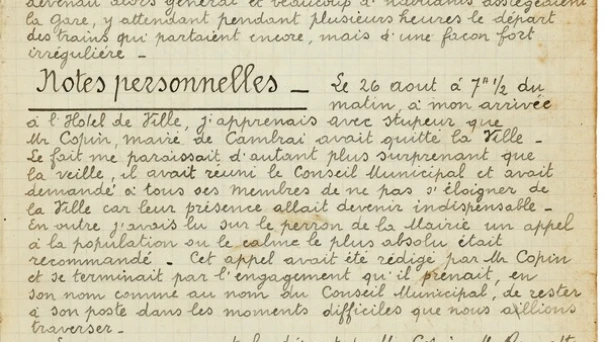
Georges Desjardin was one of the town councillors who remained at his post during the First World War. He was Mayor of Cambrai from 1925 to 1932. He died during his mandate.
Cambrai, just like Valenciennes and Douai, were demolished at the end of the 19th century. Fortifications were no longer efficient against modern weapons. The shell torpedo can pass through defensive walls from one side to another. The government and the army had opted to put in place a defensive system based on forts constructed in front of towns and capable, thanks to reinforced concrete, of resisting heavy artillery shelling.
Cambrai was therefore a town without fortifications. At the end of August 1914, heavily fortified Belgian towns fell. Liège and Brussels were invaded. Only Antwerp managed to fight off the German army.
The French army, which had entered Belgium, was obliged to retreat following the defeat in Charleroi on August 23, 1914, at the very moment when the British Expeditionary Force B.E.F., was defeated in Charleroi.
General Lanrezac ordered the 5th army to retreat towards Paris. By doing so he preserved the chances of a victorious counter-attack over the Marne, but abandoned a part of the French territory.
On August 25, German troops were positioned in the Cambrai suburbs. The Mayor of the town, Nestor Copin, fled. General Roederer prevaricated prior to being taken prisoner. The Germans invaded the town on August 26.