


-
 Accueil
>
Accueil
>
- 1914, the terrible year >
- The invasion >
- The fall of Maubeuge



The fall of Maubeuge
At the northern border, the Maubeuge stronghold made up part of the “iron barrier” created by Vauban in the 17th century. The defence system was rounded off by the construction of forts ahead of the fortification walls at the end of the 19th century, in a plan developed by General Séré de Rivière.
Nevertheless, the town’s defence system remained fragmentary and outdated, and was unlikely to resist heavy bombing.
Concerned by the invasion of Belgium and the possibility of a German attack, the governor of the stronghold, General Joseph Fournier had the defence mechanism completed, with work beginning at the start of August 1914.
Following the defeat in Charleroi and the retreat of French troops, ordered by General Lanrezac, Maubeuge found itself isolated to the north of the front line and soon to be under siege.
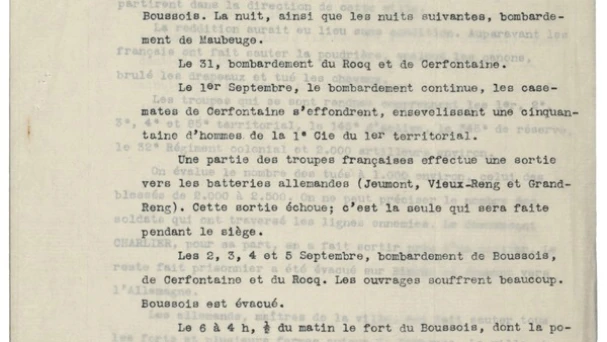
The German VII reserve corps, commanded by General von Zwehl placed the town under siege. Bombing began on August 29 at 1pm and only ceased after surrender.
Backed by the forts, the resistance of 40,000 men, reservists and auxiliaries, kept the Germans at bay for ten days and thus immobilised 60,000 Rhine and Westphalians, at the decisive moment of the Battle of the Marne.
The garrison finally surrendered with honours on September 8, 1914.