


-
 Accueil
>
Accueil
>
- 1917-1918, RECONSTRUCTION >
- Human Reconstruction >
- The Human Toll

The Human Toll
The Great War’s demographic profile in the Nord department is complex to establish. 54,184 soldiers born in the department died. Close to 580,000 of 40 different nationalities fell in the Nord and Pas-de-Calais departments according to a census made during the building of the Ring of Remembrance.
Then, one needs to count the excessive mortality rate across the department.
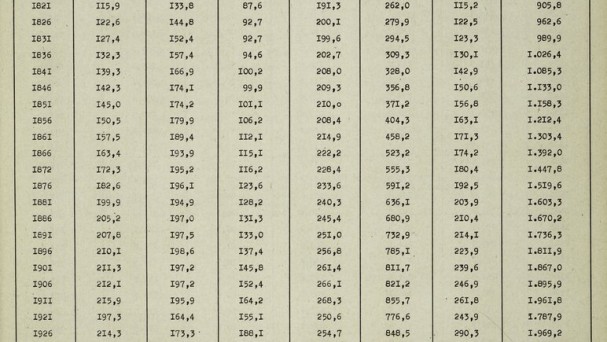
Censuses make it possible to evaluate the population’s evolution. The Lille district lost 79,100 habitants between 1911 and 1921, or 9.24% of its population; the department, 179,900 habitants, or 8.86% of its population. Soldiers would then represent 31% of the department’s losses.
The population decrease may be attributed to a high civilian mortality rate but also the shortfall of births and population movements. The high civilian mortality rate in the Nord department may be estimated at between 8000 and 10,000 individuals per year depending on the years, or approximately 40,000 individuals over the entire war. The shortfall of births is even more important: from 40,000 in 1913, births collapsed during the war to around 10,000. It’s not until 1920 that pre-war levels were again reached. In all, approximately 125,000 births did not occur.
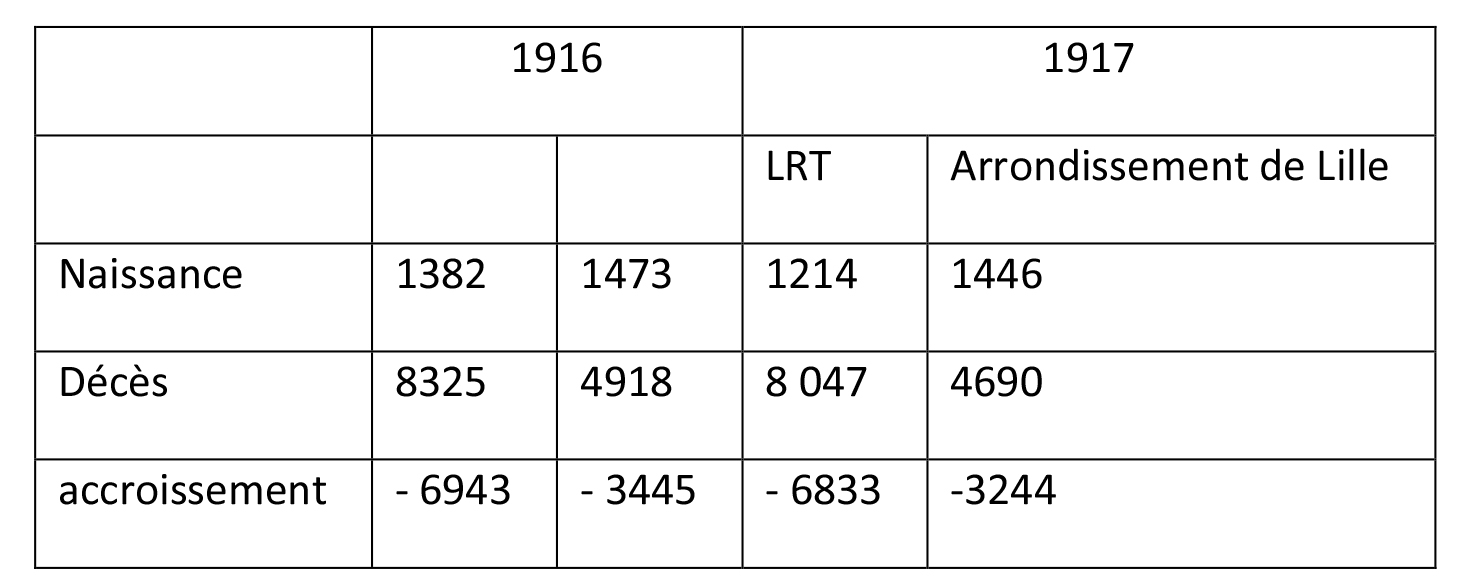
D’après l’annuaire statistique régional, édition 1951, B.A. 8930
Central cities (such as Lille, Roubaix, and Tourcoing) lost their population during the Great War while suburban cities (Lambersart, Haubourdin, Marcq-en-Barœul) saw their population stabilise, even progress. The trend was continuous from 1901 to 1946.
Évolution entre 1911 et 1921
D’après l’annuaire statistique régional, édition 1951, B.A. 8930