


-
 Accueil
>
Accueil
>
- 1917-1918, RECONSTRUCTION >
- Reconstitution >
- Industrial reconstruction

Industrial reconstruction
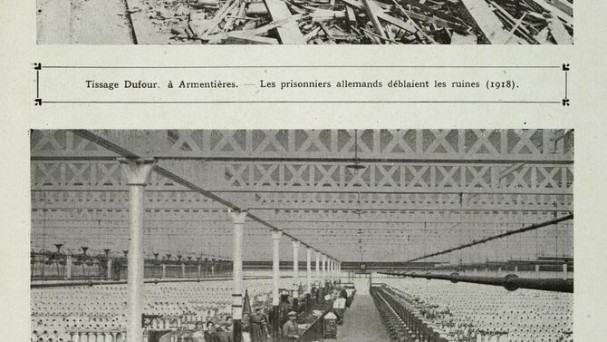
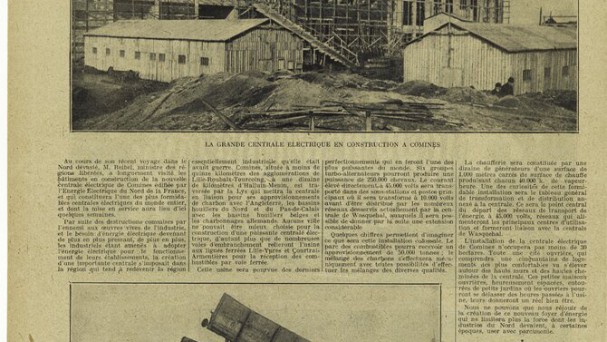
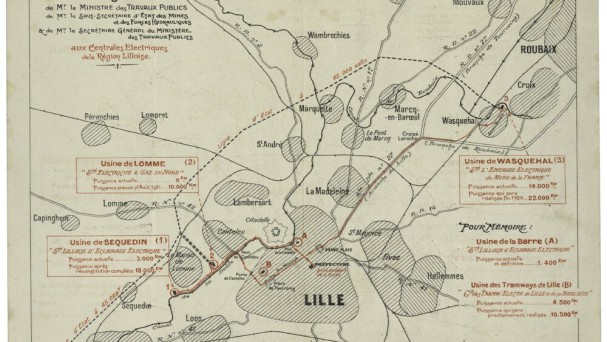
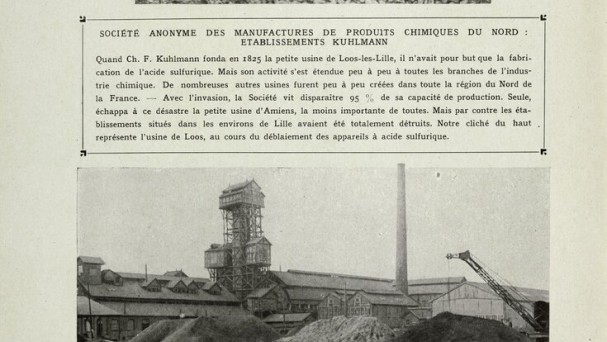
As a first step, priority was given to starting up the least affected companies. The State supplied equipment recovered from Germany so production could start up more quickly. The industrial reconstruction was left to private initiatives with large support from the State (which immediately advanced 30% of estimated war damages) and Chambers of Commerce. Banks in anticipation of being compensated loaned generously to businesses whose credit was not discussed. In Tourcoing, the Motte-Frères cotton spinning mill reopened its doors in June 1919 and the Tiberghien-Frères textile factories were again operating in July that same year. In the mines, the least damaged wells picked up operation as early as the Autumn of 1919. Elsewhere, flooding had to be stopped and water pumped, railroads and surface installations rebuilt, hoists raised with the help of masts and winches or rebuilt when metallic beams were cruelly missing (reinforced concrete was used but those hoists were extremely heavy). The Aniche mines’ Gayant pit was back in operation in 1925 only. In Douai, the “groupement des houillères du Nord-Pas-de-Calais » (Nord-Pas-de-Calais Mining Group) was created in 1920 to centralize and manage the State accounts for war damages to accelerate reconstruction and limit foreign, notably British, competition. The Nord Mines recovered their 1912-1913 results as early as 1924-1925 and often with superior yields. New extraction wells were even opened in Lallaing in 1923-1925, Pecquencourt (1921), and Lewarde (1927). In parallel, new mining transformation mills were built like the coke oven in Auby or the Waziers chemical factories. Particular interest was paid to thermal power plants as demand for electric energy never ceased to increase. In Valenciennes, the completely destroyed plant was rebuilt in 1920. The Wasquehal thermal power plan had greatly suffered from the occupation, and in 1919, “the electric energy of the Nord region of France” restarted operations. That same year they decided the construction of a new 150,000 kW unit in Comines along the Lys which was completed in 1921. The Kuhlman company, after having restored the least damaged installations, took advantage of reconstruction to adopt new manufacturing processes, a new geographic distribution of its French factories, and to produce new product. Victimized millers grouped in 1920 with the “Lilloise Meunerie” and built an ultra-modern flour mill in Marquette, along the edges of the Deûle which was put in operation in June 1923. Certain industries such as the brewers and distilleries never rose up after the war; glassworks found it difficult to start up again.
These several examples of successful reconstruction should not hide that the region’s industrial profile was restored to such as it was before the war. Innovation was rare. Industry was as little diversified as it was in 1914. The traditional industries which created the Nord’s wealth in the 19th started up again while increasing production capacities: coal, metalworking, and textile.