


-
 Accueil
>
Accueil
>
- 1917-1918, RECONSTRUCTION >
- Reconstitution >
- Reconstruction of La Bassée

Reconstruction of La Bassée
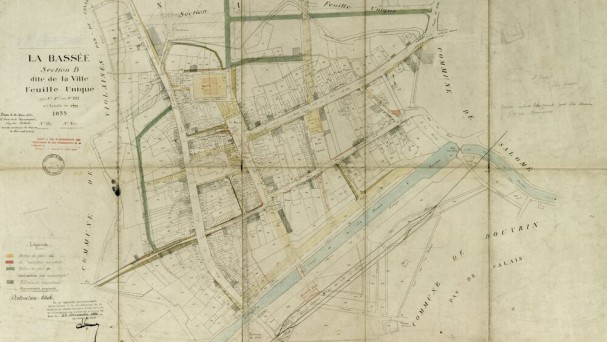
The city had been completely destroyed during the war and the municipality entrusted the establishment of the urban renewal and expansion plan to the architect Léon Debatte, the former municipal architect of Aire-sur-la-Lys, recently named to La Bassée. The city’s reconstruction was an opportunity to modernise. The train station which had been removed from the centre was moved nearer. A 20-metre wide artery connected the station to the Grand Place which was also widened. This new thoroughfare extended beyond the square and joined a boulevard around which it was planned to build new neighbourhoods. Schools and the hospice enclosed a public garden and sports fields. In the city, alignments were corrected, streets widened, and angles cut. Public facilities were added to the ensemble: public baths, a covered market, a swimming school, and public electric or gas lighting. A sewage system was built for the city. A water tower provided distribution of water, a collector sewer led waste waters towards settling basins, and a water treatment plant. On drawings by A. Franquet, the new La Bassée city looks spacious, cut through with wide avenues and green areas: the perfect city. Fairly strict regulations were applied to the reconstruction of housing. Building heights were to be proportional to the street’s width: 6 metres. For a street less than 12 metres wide; 19 metres for a street of 12 to 15 metres and 20 beyond. Ceiling heights were not less than 2.80 metres at ground level and 2.6 metres for the upper levels. Each house of more than 3 habitable rooms was equipped with public drinking water and sanitary facilities with lighting and a water supply. The reconstructed buildings took on the same look of the pre-war buildings with a non-regional style where gables were rare. However, the use of brick preserved local style. The city hall was placed in the perspective of the new artery which led to the train station. Breaking with the former building, the new one was built in a neo-Renaissance style.