


-
 Accueil
>
Accueil
>
- 1917-1918, RECONSTRUCTION >
- Reconstitution >
- Reconstruction of Lille



Reconstruction of Lille
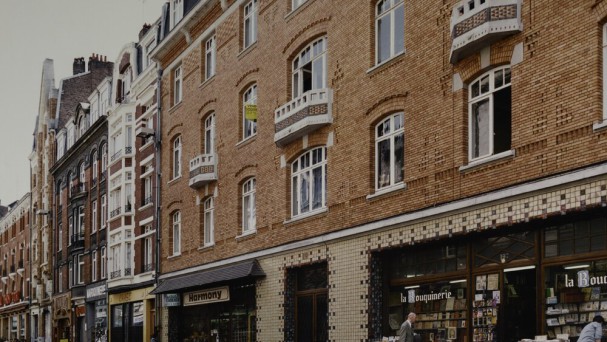
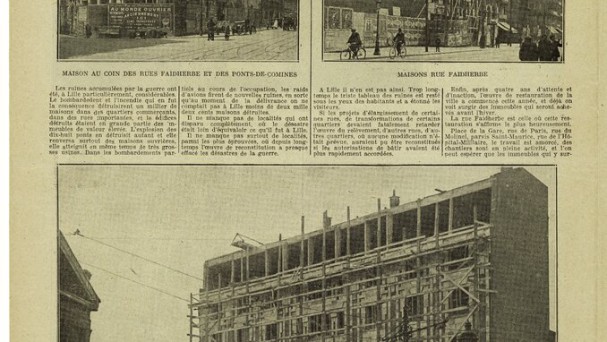
Reconstruction had to tend to the most urgent: reorganisation of the city centre and restarting industry in the war-ravaged Moulins neighbourhood. The urgency of the situation and financial difficulties led to a number of questionable solutions. In the Moulins district, factories and housing were rebuilt with little improvement. Specifically, the courée system was preserved. Of course, certain improvements were made: generally, the houses were enlarged with the addition of an upper level. But no urban planning policies were implemented. As a result, rue de Ronchin (rue Jean-Jaurès today) which was completely rebuilt after the war looks as though it stepped out of the 19th century. In the city centre, broadening of streets and laying of new streets was limited. The slowness of the reconstruction was regularly denounced by the press and local residents. The primary problem was compensating the owners of buildings left standing in areas which were in large part destroyed. As a result, to widen the rue de Bethune, one side of the street was destroyed as the other had been bombed. And contrary to what had taken place in Cambrai, the State refused to take on the cost of expropriations and the project for widening the street was abandoned at the end of the 1920’s. Priority was given to rebuilding rue Faidherbe. Despite modern techniques using reinforced concrete, the decor remained unchanged, inspired by the eclectic bourgeois taste of the 19th century. One must move on to adjacent streets to discover several original buildings marked by Expressionism. The influence of the decorative arts is quite obvious in the building on rue de l’Hôpital Militaire attributed to the father and son architects Louis-Marie and Louis-Stanislas Cordonnier. The care paid in the selection of materials and the quality of work on reflections are most remarkable.
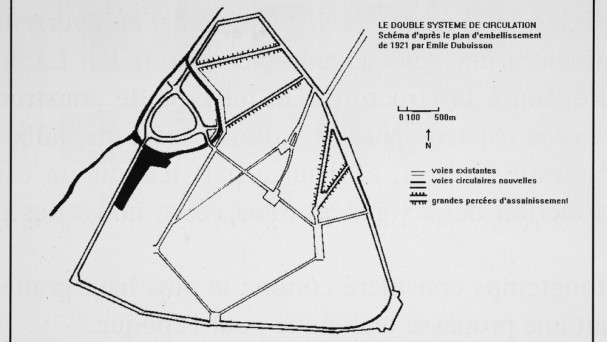
Peace, the Treaty of Versailles, and the promise of reparations gave rise in Lille to the hope of rational urban planning in a city marked by industry. The Law of 19 October 1919 which finally declassified Lille as a military stronghold authorized the dismantling of the surrounding fortifications. 400 hectares were added to the 700 of the walled-city. During the war, the “Friends of Lille” had already established an urban planning commission. The socialist municipality took over the project and on May 3, 1920, launched a contest for ideas and the prize-winners - Jacques Greber and Louis-Stanislas Cordonnier - were ousted in favour of Emile Dubuisson. The 1921 urban revitalisation plan was organised around several major constraints imposed in fact by the municipality. The essential objective was to “recentre” the city around city hall which had been rebuilt in the working-class Saint-Sauveur neighbourhood. The pushing back of the train station and its transformation into a through station was in the same vein: widening the existing centre. Movement within and around the city was improved with the creation of a two-way traffic system: the inside loop was to be completed with the creation of an artery at the foot of the Notre-Dame de la Treille cathedral; a circular boulevard replaced the ramparts and shaped the backbone of a green belt; a new artery was imagined which would link Lille and Armentières starting from the Lille-Roubaix-Tourcoing Grand Boulevard. Moving city hall and laying new arteries was an opportunity for sanitary operations: the Saint-Sauveur neighbourhood, known for its unhealthy living conditions, was to be razed and the municipality began buying back war damages from individual owners. On completion, the reconstruction failed to entirely satisfy expectations. The dismemberment consumed a large part of the city’s financial potential. The 1921 plan should have been a model for renewed local management but it lacked audacity, and continued with urban planning recipes of the 19th century: destruction and remediation of the former make-up, recentring the city, and improving traffic. The new ideas presented in the Jacques Greber and Louis-Stanilaus Cordonnier project where one can see both the influence of ideas by Tony Garnier and that of the Anglo-Saxon models, were completely abandoned.
The essential accomplishment of the 1921 plan was the building of the new city hall which was at the centre of the urban model imagined by Emile Dubuisson, a symbol of the dream of a new world emerging from war. The building was installed on the Ruault square several feet from the spot where The Internationale was composed. A network of radiating streets was to lead to the through train station, the Grand Place, and the Place de la République. A new neighbourhood was planned and inspired by the works of Emile Dubuisson. The perspectives thus created would add solemn dignity to the building and cast the belfry as the firmament of renewed power. The project was part of an ideological and political debate after the war. Deprived of Marxism by the exalted Nation and the Union Sacrée, some of the SFIO (the French Section of the Workers’ International) sought to redefine their political aspirations. The American influence is visible in all aspects. The size of the building (104 metres for the “municipal street”, the large hall in the administrative wing) can only be explained from the perspective of Grand Lille, a vast metropolitan area, and the only one capable of imposing the city as a capital. However, this was not only a question of territoriality; like the very decentralised administrative system of Anglo-Saxon countries, the cities would see their power extend to social services, education, and more.
Everything in the decor also points to the influence of the great American banks: vast halls, wide open counters, even the clocks announce the supposed exactitude of the American giant, already a champion of logistics.